
For DIN 913 vs DIN 914 vs DIN 915 vs DIN 916 set screw sourcing, the direct answer is: choose DIN 913 flat point when you want less surface damage, DIN 914 cone point when strong bite is needed and marking is acceptable, DIN 915 dog point when the screw must locate into a hole or groove, and DIN 916 cup point for the most common general-purpose shaft, collar, pulley, and hub locking applications. A correct RFQ should define the point standard, diameter, length, thread pitch, hex socket size, property class or material, hardness, finish, oil protection, packing, labels, and inspection evidence.
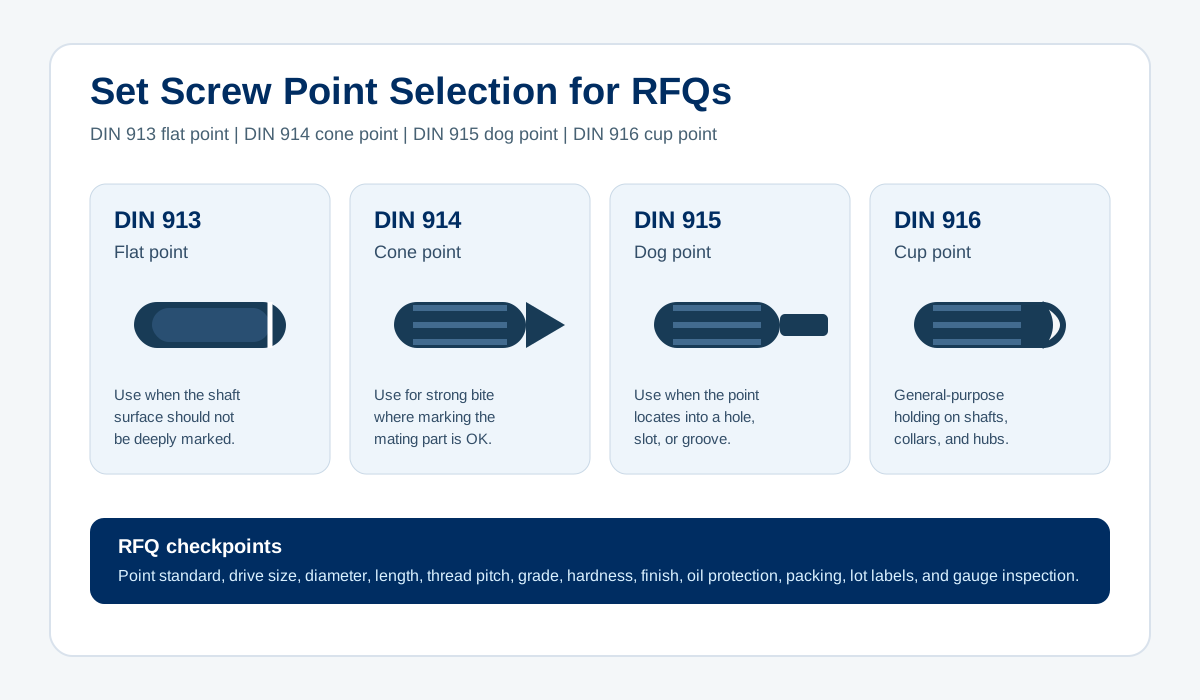
Short answer for set screw buyers
A set screw, also called a grub screw in many markets, is a headless threaded fastener used to lock one part against another. The point is the working end. It decides whether the screw presses gently, bites aggressively, locates into a prepared hole, or grips a shaft with a cup edge.
For purchasing, the point standard is not a small detail. If the drawing calls for DIN 916 cup point and the supplier ships DIN 913 flat point, the screw may fit the thread but fail to hold the shaft correctly. If DIN 914 cone point is used where the shaft surface must remain clean, the assembly may work mechanically but create a surface-damage complaint.
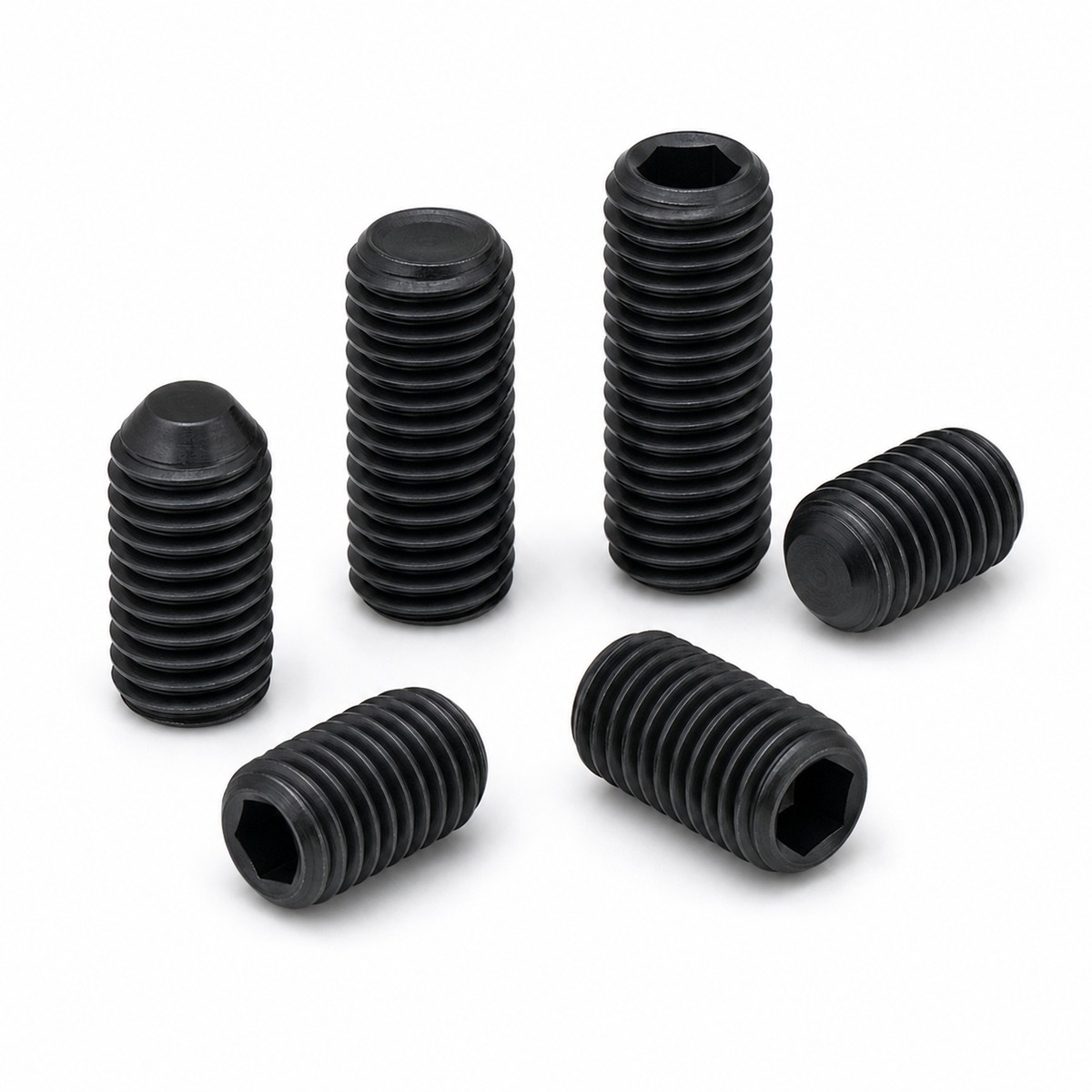
DIN 913 vs DIN 914 vs DIN 915 vs DIN 916 comparison
| Standard | Point type | Best sourcing use | Main risk if substituted |
|---|---|---|---|
| DIN 913 | Flat point | Soft shafts, flat machined seats, temporary adjustment, or applications where deep marking should be reduced | May provide less holding bite than cup or cone point in rotating shaft assemblies |
| DIN 914 | Cone point | Permanent or high-bite positioning where the cone can indent the mating part | Can mark or damage shafts and may be unacceptable for reusable or cosmetic parts |
| DIN 915 | Dog point | Positive location into a drilled hole, slot, groove, or alignment feature | Will not seat correctly if the mating hole depth or diameter is wrong |
| DIN 916 | Cup point | General-purpose locking of collars, gears, pulleys, knobs, hubs, and shaft-mounted parts | May mark the shaft and should not be treated as a non-marring point |
What buyers should specify in the RFQ
Do not request only "M6 set screw" or "grub screw black". Two suppliers may quote different point styles, socket depths, hardness levels, thread pitch, oil protection, packing counts, and inspection documents. For distributor programs and machinery spare parts, that creates receiving disputes because the item looks small but controls assembly function.
| RFQ field | What to write | Why it matters |
|---|---|---|
| Point standard | DIN 913 flat, DIN 914 cone, DIN 915 dog, DIN 916 cup, or buyer drawing | Controls how the screw contacts the mating surface |
| Size | Diameter, length, thread pitch, chamfer rule, and any tolerance from the drawing | Prevents thread fit and engagement-length problems |
| Drive | Hex socket size, socket depth, slotted drive, or special drive requirement | Weak or shallow sockets can round during installation |
| Material and grade | Hardened carbon steel, 45H where required, stainless 304/316, or project material | Strength and corrosion behavior depend on material selection |
| Finish | Black oxide with oil, plain oiled, zinc plated, stainless passivated, or drawing finish | Small screws rust easily in storage if protection is not defined |
| Packing | Bulk bag, small box, kit pack, anti-rust bag, carton label, barcode, or customer part number | Mixed set screw sizes are difficult to sort after receipt |
How to choose the point type
Start with the mating surface. If the set screw presses against a precision shaft that should be reused, a flat point may be preferred when the design provides a flat seat. If the screw must bite strongly into a shaft and surface marking is acceptable, a cone point or cup point may be better. If the point enters a prepared location hole, dog point geometry should be checked against the hole diameter and depth.
For replacement parts, inspect the existing screw before ordering. Buyers should confirm whether the end is flat, conical, cylindrical, or concave. A phone photo can help, but a drawing is better because the supplier still needs the exact diameter, length, pitch, material, hardness, and finish.
Grade, hardness, and material decisions
Many carbon steel socket set screws are ordered as hardened parts, and 45H is a common requirement in metric set screw programs. Stainless set screws are used when corrosion resistance is more important than high bite strength, especially in food equipment, light machinery, marine-adjacent hardware, and clean assemblies. Buyers should not assume stainless and hardened carbon steel are interchangeable.
| Decision | Carbon steel set screw | Stainless set screw |
|---|---|---|
| Typical finish | Black oxide with oil, plain oiled, zinc plated where suitable | Stainless natural finish, passivated if required |
| Common use | Machinery collars, pulleys, tools, fixtures, shafts, and industrial hardware | Corrosive or appearance-sensitive assemblies where stainless material is specified |
| Inspection focus | Hardness, socket strength, thread gauge, point geometry, oil protection, and rust check | Material grade, thread gauge, point geometry, galling risk, and surface cleanliness |
| Buyer caution | Black oxide is not outdoor corrosion protection by itself | Stainless may not match hardened carbon steel holding behavior |
Inspection checklist before shipment
- Confirm the point standard on every line item: DIN 913, DIN 914, DIN 915, DIN 916, or drawing.
- Check diameter, length, thread pitch, chamfer, and thread gauge fit.
- Inspect socket size and socket depth so the installation key seats correctly.
- Verify hardness or material certificate when required by the buyer.
- Review point shape under adequate magnification, especially for small M3, M4, and M5 sizes.
- Check black oxide color, oil coverage, rust protection, and carton moisture control.
- Confirm bag labels, carton labels, lot numbers, customer part numbers, and mixed-size separation.
- Assemble samples in a mating threaded hole where the buyer provides a test nut, collar, or fixture.
Packaging and export notes
Set screws are small, dense, and easy to mix. A carton of M5 x 8 cup point screws can look similar to M5 x 10 flat point screws unless the inner bags and labels are controlled. For export orders, HDBOLT recommends separate inner bags by size and point type, clear carton labels, lot traceability, and moisture protection for black oxide or plain oiled carbon steel parts.
If the shipment includes related hardware, quote set screws together with machine screws, socket cap screws, low head socket screws, hex nuts, and flat washers. Consolidated packing reduces receiving work, but only if each line item remains separated and labeled.
Handan Yongnian sourcing context
In Handan Yongnian sourcing, set screws are often purchased as part of a wider socket screw or machinery fastener order rather than as a standalone container item. The practical buyer advantage is consolidation: HDBOLT supplies DIN 913, DIN 914, DIN 915, DIN 916, socket cap screws, washers and nuts, with item-specific labels and inspection before export.
Because set screw programs can involve many small sizes and point styles, the important local-market control is not a generic claim about capacity. It is disciplined item matching, sample checking, rust prevention, and clean carton labeling before the goods leave China. Current availability and lead time should be confirmed at inquiry time because material, finish, size mix, and packaging format affect the supply schedule.
RFQ wording buyers can copy
DIN 916 cup point socket set screw, M6 x 10, coarse metric thread, hardened carbon steel 45H, black oxide with oil protection, hex socket drive per standard, packed 1,000 pcs per labeled bag and 10 bags per export carton. Confirm thread gauge fit, socket depth, point shape photos, hardness report if available, rust protection, carton labels, and destination: [country and port].
DIN 915 dog point set screw, M8 x 20, stainless 304, natural finish, dog point dimensions per DIN standard unless drawing differs, packed by customer part number with lot code. Confirm dog diameter and length, thread gauge, socket fit, material grade evidence, and mixed-size separation.
What HDBOLT recommends
Choose the set screw point by how the assembly locks, not by the cheapest available stock. Use DIN 913 for flatter contact, DIN 914 for strong bite, DIN 915 for positive location, and DIN 916 for common shaft and collar locking. For related products, review HDBOLT's set screw page, screw category, HDBOLT supply and quality guide, and socket cap screw sourcing guide. To request a quote, send the point standard, size list, material, finish, quantity, packing rule, and destination through the HDBOLT contact page.