
For brass threaded insert sourcing, the direct answer is: choose heat-set inserts for many thermoplastic and 3D-printed parts, press-in inserts when the design uses controlled interference in softer materials, and screw-in inserts when the host material needs an external self-tapping thread. Do not compare quotes until the host material, insert type, thread size, outside diameter, length, knurl or external thread style, installation method, inspection scope, and packing labels are all defined.
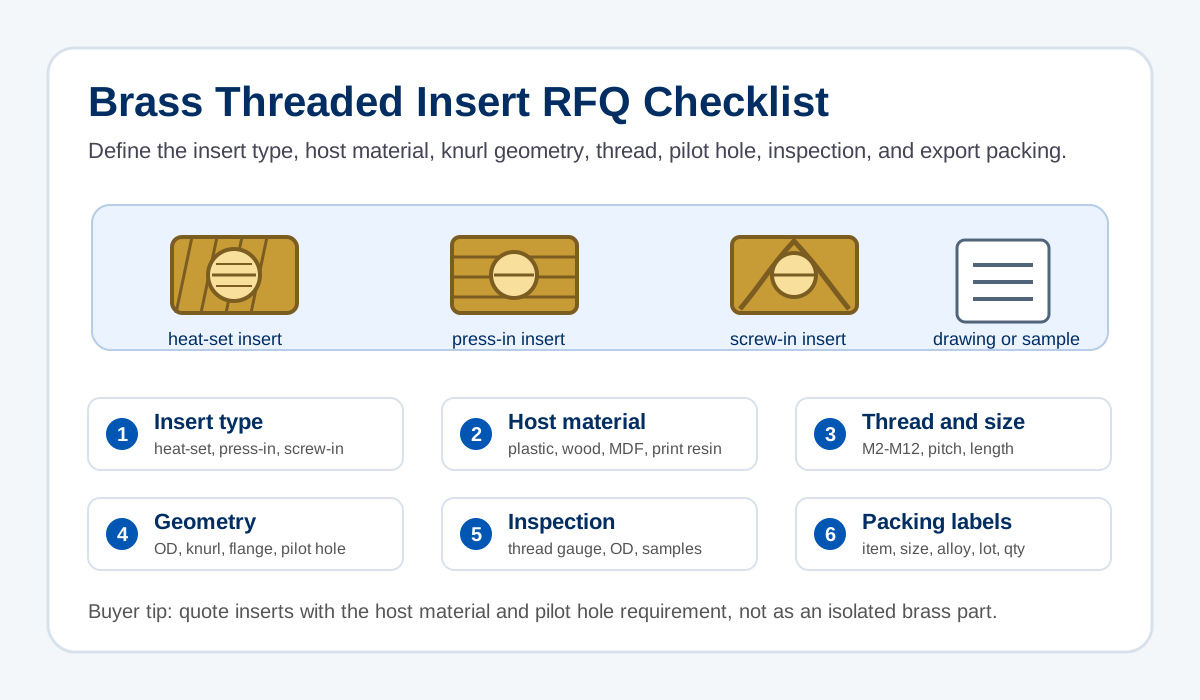
Short answer for insert buyers
A brass threaded insert creates a reusable metal thread inside plastic, wood, MDF, composite, or 3D-printed parts. The insert is usually purchased by thread size, length, outside diameter, knurl or external thread geometry, alloy, finish, and installation method. A supplier cannot quote the correct part from "M4 brass insert" alone.
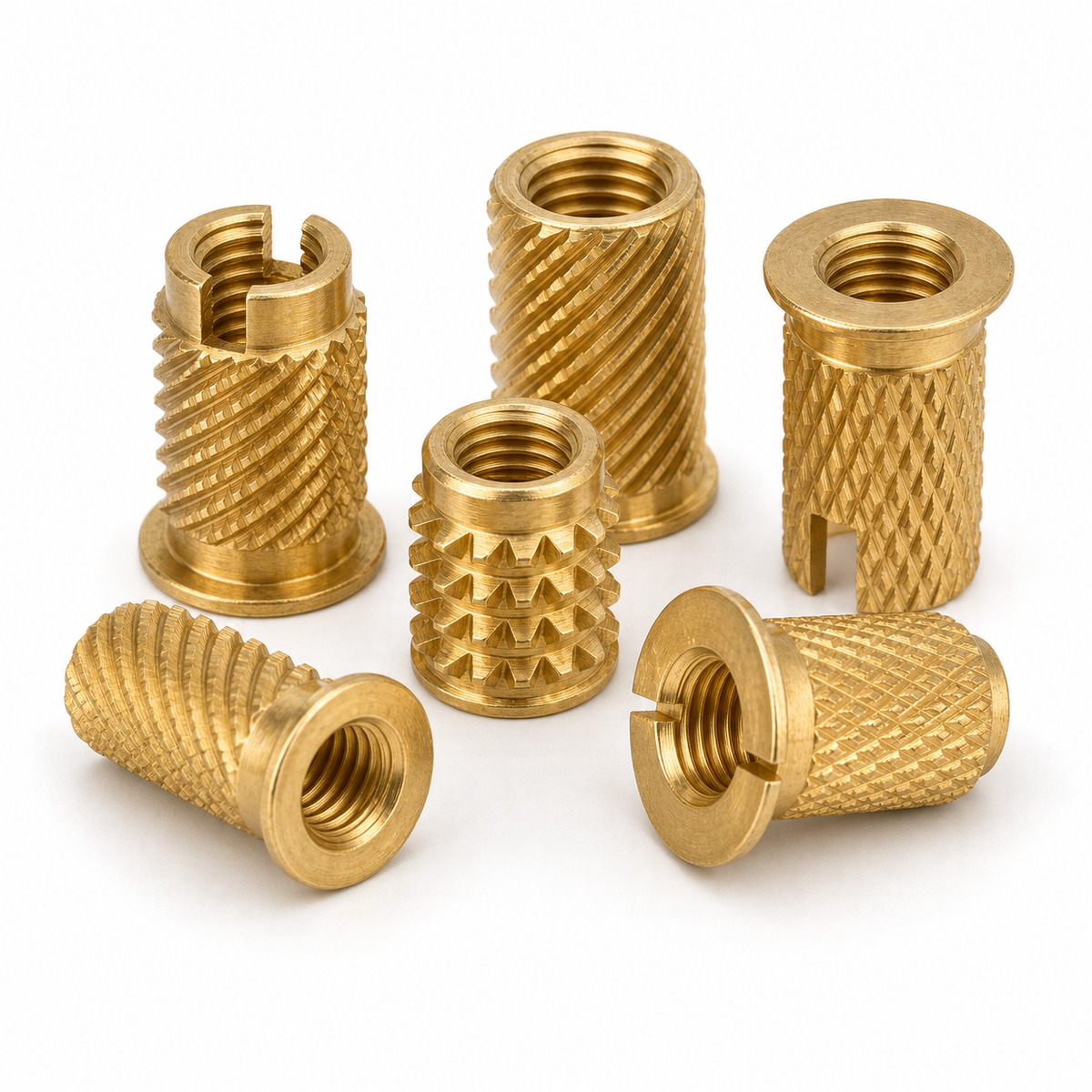
Heat-set, press-in, and screw-in inserts may look similar in a spreadsheet, but they transfer load to the host material in different ways. Heat-set inserts rely on controlled melting and cooling around the knurl. Press-in inserts rely on interference and rib bite. Screw-in inserts rely on an external thread cutting or forming into the host material.
| Buying question | Heat-set insert | Press-in insert | Screw-in insert |
|---|---|---|---|
| Typical host material | Thermoplastics and many 3D-printed parts when heat installation is approved | Plastic, wood, MDF, or soft materials with controlled hole fit | Wood, plastic, and softer substrates that accept an external thread |
| How it holds | Heated brass melts the surrounding plastic, then locks as the plastic cools | Knurls, ribs, or barbs bite into a prepared hole | External thread cuts or forms into the host material |
| RFQ-critical geometry | OD, length, knurl pattern, flange, lead-in, pilot hole | OD, rib or knurl height, length, flange, pilot hole | External thread, internal thread, length, drive style, pilot hole |
| Main sourcing risk | Wrong knurl, poor melt flow, loose pull-out performance, or damaged threads | Wrong OD tolerance, cracked host part, weak retention, or mixed lengths | Wrong external thread, split material, poor drive fit, or installation damage |
When to choose heat-set brass threaded inserts
Heat-set inserts are often the best commercial choice for molded thermoplastic parts, electronics housings, and 3D-printed prototypes that need a durable machine-screw thread. They are installed with a heated tip or soldering-iron-style tool, so the buyer should confirm the host material and installation process before approving the insert geometry.
The RFQ should state the plastic family if known, such as ABS, PC, PA, PETG, PLA, PP, or another engineering plastic. If the insert will be used in a printed part, include the print orientation, wall thickness around the boss, and pilot hole dimensions when available. The supplier can quote the insert, but the buyer's part designer must confirm boss design, installation temperature, pull-out requirement, and torque-out requirement.
When press-in or screw-in inserts fit better
Press-in inserts are useful when the assembly process cannot use heat or when the host part is designed around a tight interference fit. They can work well in selected plastics, wood products, MDF, and furniture components, but the hole tolerance and material condition must be controlled. A press-in insert that is too aggressive can crack the host part; one that is too smooth or undersized can pull out.
Screw-in inserts are useful when the buyer wants an external self-tapping form that can be driven into a prepared hole. They are often considered for wood, plastic, repair work, furniture hardware, and applications where a larger external thread provides retention. The RFQ should define the drive style, external thread, pilot hole, and whether installation tooling is part of the order.
RFQ checklist before comparing quotes
| RFQ field | What to specify | Why it matters |
|---|---|---|
| Insert type | Heat-set, press-in, screw-in, molded-in, ultrasonic, drawing part, or sample match | Prevents suppliers from quoting a different retention method |
| Host material | Plastic grade, wood, MDF, composite, resin, or 3D-printed material | The same insert can behave differently in different substrates |
| Thread | Metric or inch size, pitch, class or tolerance if required, thread depth | Controls mating screw fit and reusable thread quality |
| Body geometry | Outside diameter, length, flange diameter, lead-in, knurl, rib, or external thread | Controls retention, installation force, and boss design compatibility |
| Pilot hole | Drawing hole size, tolerance, boss wall thickness, and installation direction | Loose or cracked assemblies usually start with hole mismatch |
| Material and finish | Brass alloy, natural brass, nickel plated, tin plated, or buyer-approved finish | Appearance, conductivity, corrosion behavior, and solderability can differ |
| Inspection evidence | Thread gauge, OD and length report, sample photos, knurl comparison, packing photos | Small inserts are easy to mix and hard to identify after shipment |
| Export packing | Bag quantity, inner box, carton weight, labels, lot separation, and moisture protection | Prevents mixed sizes, tarnish complaints, and receiving delays |
Inspection points buyers should request
Brass threaded inserts are small, but they should not be treated as low-risk commodity pieces. Ask for thread gauge checks, outside diameter and length checks, knurl or external thread photos, flange diameter checks where applicable, and sample installation feedback if the supplier can test against a matching host material. For critical parts, the buyer should define pull-out and torque-out testing with the approved host part or a representative test coupon.
| Checkpoint | What to check | Buyer note |
|---|---|---|
| Thread fit | Go/no-go gauge or mating screw run-in | Blocked or rough internal threads cause assembly line stoppages |
| Outside diameter | OD, knurl peak, rib height, or external thread major diameter | Retention depends on the outer geometry |
| Length | Total length and usable thread depth | Too long can bottom out; too short can reduce thread engagement |
| Appearance | Burrs, chips, plating coverage, tarnish, and oil residue | Inserts are often used in visible or electronics-adjacent products |
| Packing | Separate bags by size, length, type, alloy, and lot | M3 and M4 inserts can be difficult to separate after mixing |
Alloy, finish, and application notes
Natural brass is common because it machines well and has a recognizable yellow metal appearance. Nickel plating may be chosen for a brighter silver appearance and added surface protection. Tin plating may be specified for selected electrical or solderability requirements. Do not approve a plating change only from photos; state the finish and any corrosion, solderability, conductivity, or appearance requirement in the RFQ.
If the assembly also uses brass machine screws, brass hex nuts, brass washers, or stainless mating screws, quote the insert with the mating fastener. Thread fit, visible finish, and galvanic or environmental concerns should be reviewed as an assembly. For broader material selection, see HDBOLT's stainless steel A2 vs A4 fastener guide and brass fasteners category.
Handan Yongnian sourcing context
In the Handan Yongnian fastener supply base, brass threaded inserts are usually handled as a specialty line within a broader fastener sourcing program. Overseas buyers may combine inserts with screws, washers, nuts, carton labels, samples, and mixed-size kits in one shipment. The practical advantage is consolidation; the practical risk is mixing similar small brass parts that have different OD, length, knurl style, or thread pitch.
For this reason, HDBOLT treats insert sourcing as line-item control rather than a generic brass purchase. Separate each insert by drawing number, size, type, alloy, finish, and lot. Ask for bag labels and carton photos before mixed export packing, especially when one order includes many M2, M3, M4, and M5 variants.
Common RFQ mistakes
| Mistake | Likely result | Better wording |
|---|---|---|
| Writing only "brass insert" | Supplier quotes a heat-set, press-in, screw-in, or local stock pattern | State the insert type, drawing, thread, OD, length, and host material |
| No host material listed | The insert may fit the thread but fail pull-out or crack the part | State plastic, wood, MDF, composite, or 3D-printed material |
| No pilot hole control | Installation force, retention, and scrap rate vary between batches | Include pilot hole size, tolerance, boss wall, and installation direction |
| Approving by photo only | Knurl angle, OD, length, and thread depth may not match the sample | Require dimensions and sample comparison photos before production |
| Bulk packing mixed sizes | Receiving team must sort nearly identical inserts manually | Use small bags or boxes with item, size, type, alloy, finish, lot, and quantity |
RFQ wording buyers can copy
Brass heat-set threaded insert, M4 x 0.7 internal thread, natural brass, for thermoplastic enclosure boss. Quote by drawing with OD, length, flange diameter, knurl pattern, pilot hole recommendation, thread gauge inspection, sample photos, bag labels by item number, and export carton photos before shipment.
Brass screw-in threaded insert, M6 internal thread, external self-tapping thread, natural brass or nickel plated as approved, for wood furniture assembly. Confirm pilot hole, drive style, outside thread dimensions, usable thread depth, burr control, carton weight, lot labels, and mixed-item pallet separation.
What HDBOLT recommends
Choose the insert by host material and installation method first, then lock the geometry into the RFQ. Heat-set inserts are usually the right starting point for many thermoplastic and 3D-printed applications; press-in inserts need tight hole control; screw-in inserts need external thread and drive details. To quote brass threaded inserts, send drawings, host material, pilot hole details, sizes, finish, quantity, inspection needs, and destination through the HDBOLT contact page. For related products, review the brass threaded insert page, brass category, and the HDBOLT supply and quality guide.