
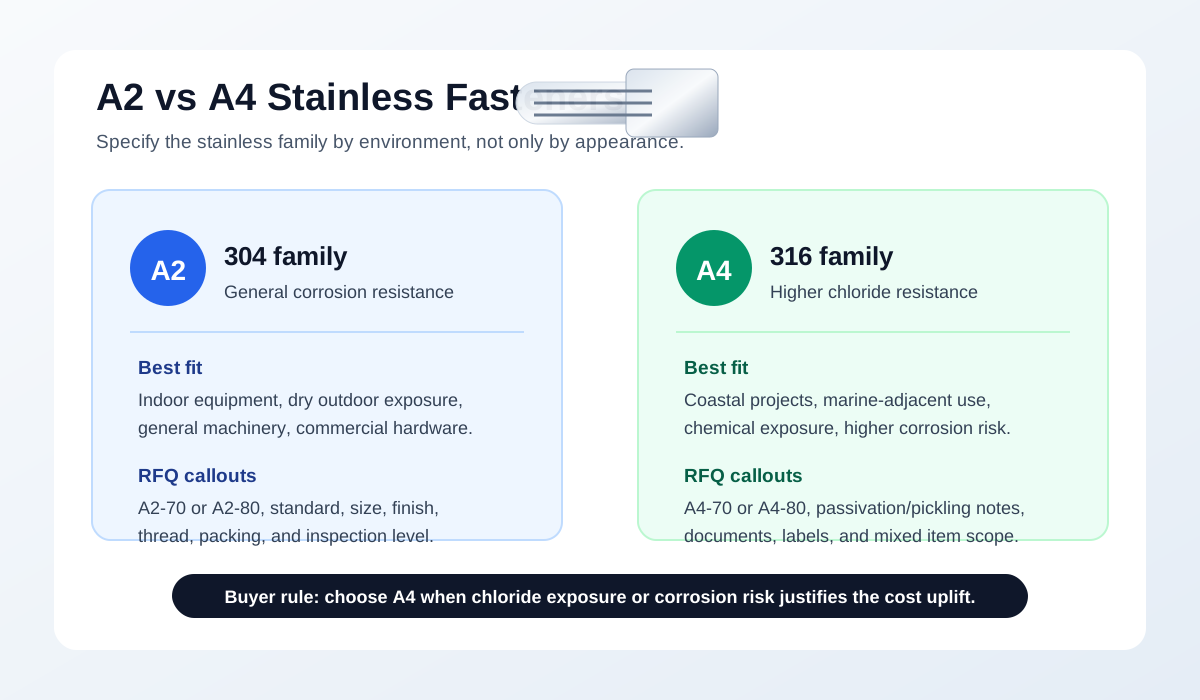
For sourcing, the short answer is: choose A2 stainless steel fasteners for general indoor, machinery, and low-corrosion outdoor use; choose A4 stainless steel fasteners when chloride exposure, coastal air, marine-adjacent projects, or chemical environments make corrosion resistance more important than the lowest unit price.
Direct answer for import buyers
A2 stainless fasteners are commonly associated with the 304 stainless family and are suitable for many general applications. A4 stainless fasteners are commonly associated with the 316 stainless family and are selected when stronger chloride and corrosion resistance is required. If the drawing, project specification, or end customer requires A4, do not substitute A2 just because the dimensions match.
When sending an RFQ, write the stainless family and property class together, such as A2-70, A2-80, A4-70, or A4-80. Then add the product standard, size, thread, finish condition, inspection documents, packaging, and destination.
| Selection factor | A2 stainless fasteners | A4 stainless fasteners |
|---|---|---|
| Common material family | 304 stainless family | 316 stainless family |
| Best sourcing fit | General machinery, indoor hardware, dry exterior use | Coastal, marine-adjacent, chemical, higher corrosion exposure |
| Typical callouts | A2-50, A2-70, A2-80 | A4-50, A4-70, A4-80 |
| Main buyer risk | Using A2 where chloride exposure requires A4 | Paying for A4 when the application only needs A2 |
| RFQ priority | Grade, standard, thread, finish, packing | Grade, corrosion environment, documents, lot separation |
Why A2 and A4 should not be quoted as interchangeable
A2 and A4 fasteners can have the same dimensions, head style, and thread, so they may appear interchangeable in a warehouse. In purchasing, they are not the same sourcing item. A4 normally carries a higher material cost and is chosen for environments where the extra corrosion resistance is needed. A2 can be the better commercial choice when the application does not justify A4.
This matters for stainless steel hex bolts, stainless steel hex nuts, stainless threaded rods, screws, anchors, and washers. If your order mixes several stainless product families, each line item should state A2 or A4 instead of using a single note at the top of the RFQ.
How to choose between A2-70, A2-80, A4-70, and A4-80
The number after the stainless family indicates the strength class. Many commercial stainless fastener RFQs use 70 class, while 80 class may be specified where higher strength is required. Buyers should follow the drawing or engineering specification first. If no property class is listed, confirm it before comparing supplier prices.
| RFQ wording | What it tells the supplier | Buyer note |
|---|---|---|
| A2-70 | A2 stainless family with 70 class strength | Common general stainless fastener callout |
| A2-80 | A2 stainless family with higher strength class | Confirm availability by size and product type |
| A4-70 | A4 stainless family with 70 class strength | Common when corrosion resistance is the main driver |
| A4-80 | A4 stainless family with higher strength class | Specify clearly and avoid silent substitution |
Inspection and documentation checklist
- Material confirmation: require material grade records or mill documents as agreed in the purchase order.
- Marking check: confirm head or body marking where the applicable standard requires it.
- Thread fit: test representative bolts, nuts, rods, and mating parts together.
- Surface condition: check for contamination, staining, mixed lots, and handling marks.
- Lot separation: keep A2 and A4 cartons, labels, and pallet marks clearly separated.
- Packaging: specify carton weight, inner bags, pallet protection, labels, and shipping marks.
Practical Yongnian and Handan sourcing context
HDBOLT supplies stainless bolts, nuts, washers, self-tapping screws and threaded rods in mixed export orders. Material grade, surface condition, thread fit and packing separation are reviewed for each line before shipment.
The practical advantage is consolidation. HDBOLT can help separate A2 and A4 line items, align labels and packing lists, inspect the high-risk items first, and consolidate stainless fasteners with carbon steel or anchor products when the shipment requires it. That is especially useful when a buyer needs both stainless stock items and project-specific packaging under one export document set.
RFQ template line buyers can copy
Stainless steel hex bolt, ISO 4017, M10 x 40, A4-70, metric coarse thread, clean passivated surface as required, matching A4 nut and washer quoted separately, export carton plus pallet packing, line-item label with grade and lot code, destination port, inspection report required before shipment.
What HDBOLT recommends
Do not ask only for "stainless fasteners" when corrosion performance matters. Specify A2 or A4, strength class, product standard, size, mating parts, finish condition, packaging, and documents. If the application includes coastal exposure or chemical contact, confirm whether A4 is required before releasing the RFQ.
HDBOLT supports export buyers with stainless steel fastener supply, mixed-item consolidation, and pre-shipment inspection planning. Send your stainless grade, product list, quantities, packing needs, and destination through our contact page, or review the fastener ordering guide before preparing a multi-item RFQ.