
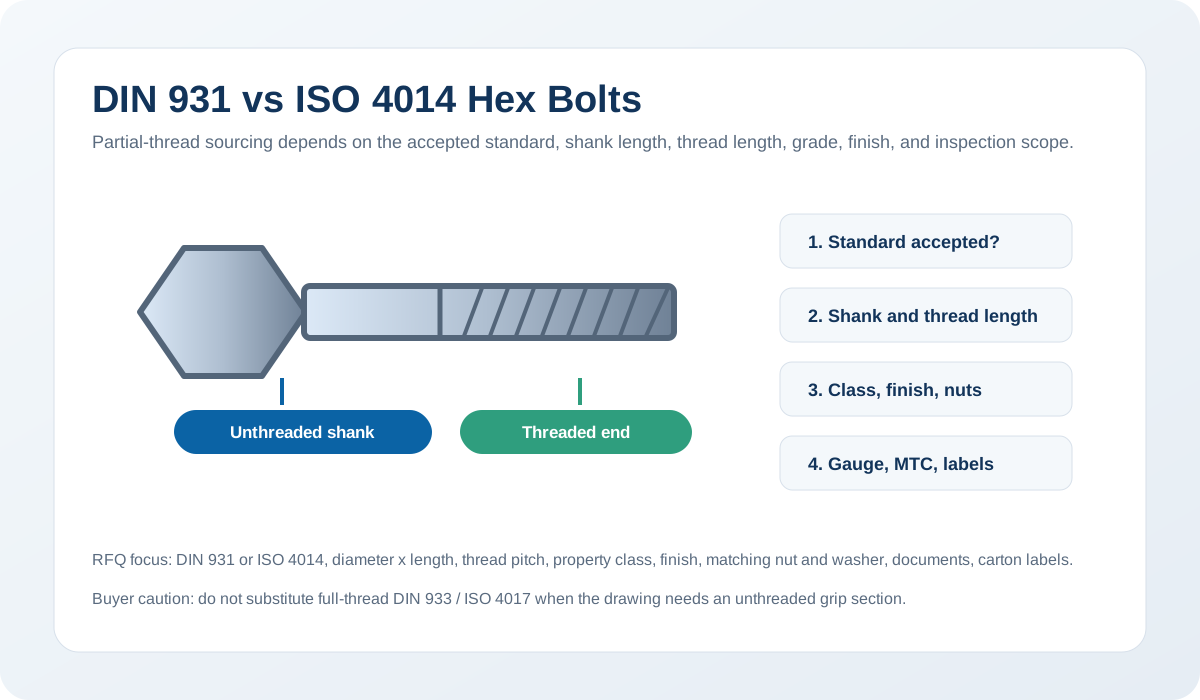
For DIN 931 vs ISO 4014 partial-thread hex bolt sourcing, the direct answer is: confirm which standard the drawing accepts, then specify diameter, length, thread pitch, unthreaded shank requirement, property class, finish, matching nut and washer, inspection documents, and export packing labels. Do not replace a partial-thread bolt with a full-thread bolt unless the engineering specification allows it.
Direct answer for import buyers
DIN 931 and ISO 4014 both describe metric hex head bolts with a partial thread. The key buyer issue is not only the head shape; it is whether the application needs an unthreaded grip section under the head. That shank can improve bearing through connected parts, control shear location, and match existing drawings where a full-thread bolt is not acceptable.
A quote-ready RFQ line should read like this: DIN 931 or ISO 4014 hex bolt, M12 x 80, coarse thread, partial thread with standard thread length, property class 8.8, zinc plated white, matched with class 8 hex nuts and flat washers, thread gauge inspection, dimensional inspection, MTC if required, export cartons on pallets with labels showing standard, size, class, finish, quantity, lot code, and buyer item number.
| RFQ field | What to write | Why it matters |
|---|---|---|
| Standard | DIN 931, ISO 4014, or buyer drawing | Prevents mixed dimensions and wrong market assumptions |
| Size | Metric diameter x overall length, plus pitch if not standard coarse | Controls fit with parts, nuts, and tooling |
| Thread form | Partial thread, standard thread length, or drawing-defined thread length | Protects the intended unthreaded grip section |
| Class | 4.8, 8.8, 10.9, 12.9, stainless A2/A4, or drawing grade | Must match the mechanical requirement and mating nut |
| Finish | Plain, black, zinc plated, hot-dip galvanized, Geomet-type coating, or stainless | Affects corrosion resistance, thread fit, appearance, and cost |
| Packing | Carton quantity, gross weight, pallet plan, lot and line-item labels | Reduces receiving errors in mixed metric bolt shipments |
DIN 931 vs ISO 4014: what buyers should check
The practical choice depends on the drawing, market expectation, and whether the customer accepts ISO substitution for older DIN references. Many buyers still write DIN 931 on purchase orders because it is familiar in distribution catalogs. Others use ISO 4014 for ISO-aligned specifications. If your customer has not approved interchangeability, quote exactly what the drawing states.
| Question | DIN 931 | ISO 4014 |
|---|---|---|
| Basic product type | Metric hex head bolt with partial thread | Metric hex head bolt with partial thread |
| Best use in RFQ | When drawing, catalog, or customer PO calls for DIN 931 | When project specification is ISO-based or accepts ISO 4014 |
| Main buyer risk | Assuming every supplier will quote ISO equivalent without approval | Assuming older DIN dimensions are always accepted by the customer |
| What to confirm | Across flats, thread length, shank length, class, finish, and nut pairing | Across flats, thread length, shank length, class, finish, and nut pairing |
Partial thread vs full thread
A partial-thread bolt has an unthreaded shank below the head and threads near the end. A full-thread bolt, such as DIN 933 or ISO 4017 hex bolt, is threaded along the body. The two can look similar in a small product photo, but they are not automatically interchangeable.
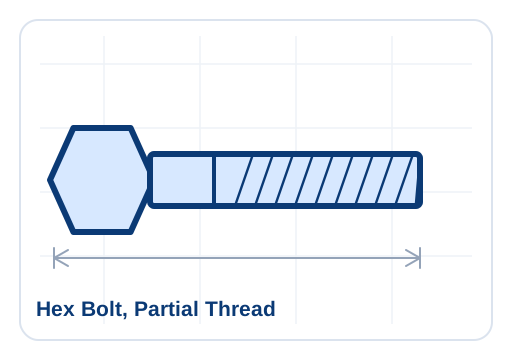
For procurement, the question is simple: does the assembly need the unthreaded part to sit through the joint? If yes, keep the DIN 931 or ISO 4014 requirement. If the bolt only clamps thin parts and full thread is acceptable, the customer or engineer should approve that substitution before purchasing.
Grade, nut, and washer matching
Metric partial-thread hex bolts are commonly requested in property classes such as 4.8, 8.8, 10.9, and 12.9. The bolt grade should be matched with a suitable nut class and washer requirement. A class 8.8 bolt usually needs a compatible class 8 nut unless the project specification states otherwise. Higher-strength classes require more careful control of material, heat treatment, coating, and certificates.
When the order includes assemblies, specify the complete set: partial-thread hex bolt, hex nut, flat washer or spring lock washer, finish, certificates, and packing. This avoids a common problem where the bolt is correct but the nut grade, washer size, or coating does not match.
Finish choices and thread fit
Zinc plated partial-thread bolts are common for general machinery, construction hardware, and distribution stock. Plain or black finish may be requested for controlled industrial use. Hot-dip galvanized bolts are often selected for outdoor exposure, but the thicker coating can affect thread fit and matching nut requirements. Stainless A2 or A4 bolts are useful for corrosion resistance, but the buyer should still define the strength class and galling precautions where needed.
| Finish | Typical buyer use | RFQ caution |
|---|---|---|
| Zinc plated | Indoor and general commercial applications | State color and plating expectation if appearance matters |
| Hot-dip galvanized | Outdoor steelwork, timber, and infrastructure hardware | Confirm nut tapping and fit after galvanizing |
| Plain or black | Industrial use, further processing, or protected environments | Define rust prevention oil and packing protection |
| Stainless A2 or A4 | Corrosion-sensitive assemblies | Specify grade, strength class, and mating stainless nut requirement |
Inspection checklist before shipment
- Confirm the carton label and packing list show DIN 931, ISO 4014, or the approved drawing number.
- Measure diameter, overall length, across flats, head height, thread length, and visible unthreaded shank.
- Check thread pitch and run-on fit with the matching nut or a go/no-go gauge.
- Verify property class marking and certificate requirements before packing.
- Inspect coating appearance, rust, dents, thread damage, and burrs.
- Separate cartons by size, standard, class, finish, and lot code for mixed export orders.
Common sourcing mistakes
| Mistake | Why it causes problems | Better RFQ wording |
|---|---|---|
| Writing only "M12 x 80 hex bolt" | Supplier may quote full thread, partial thread, DIN, ISO, or local pattern | DIN 931 M12 x 80, partial thread, class 8.8, zinc plated |
| Mixing DIN 931 and ISO 4014 without approval | Customer receiving checks may reject the wrong reference | ISO 4014 accepted as equivalent only if approved by buyer |
| Ignoring thread length | The grip section may not sit correctly through the joint | Standard thread length or drawing-defined thread length required |
| Quoting bolts without nuts and washers | Assembly price and performance are incomplete | Quote bolt with matching class nut, washer, finish, and certificates |
Practical Yongnian and Handan sourcing context
In the Yongnian and Handan fastener supply base, partial-thread hex bolts may come from different production routes than full-thread hex bolts, threaded rods, washers, or special coatings. For overseas buyers, the useful advantage is not only unit price; it is the ability to consolidate related metric fasteners under one specification, inspection, and packing plan.
HDBOLT can coordinate DIN 931 and ISO 4014 partial-thread bolts with other bolt products, nuts, washers, surface finishes, carton labels, and shipment documents. This is especially useful when one distributor order contains similar M8, M10, M12, and M16 line items that can be mixed if carton labels and lot separation are weak.
RFQ wording buyers can copy
DIN 931 hex head bolt, M12 x 80, coarse thread, partial thread with standard thread length, property class 8.8, zinc plated white, matched with class 8 hex nut and flat washer, thread gauge and dimensional inspection required, MTC if available or material certificate required, cartons under agreed gross weight, labels to show standard, size, class, finish, quantity, lot code, buyer item number, and carton number.
What HDBOLT recommends
Do not compare partial-thread hex bolt quotes using only diameter and length. State the exact standard or approved equivalent, confirm the unthreaded shank requirement, match the nut and washer, define finish, and require clear labels for every carton. For a quote, send your bolt size list, grade, finish, assembly parts, certificate needs, and destination through the HDBOLT contact page. For related reading, review our DIN 933 vs ISO 4017 full-thread bolt guide and HDBOLT supply and quality guide.