
For U-bolt sourcing, the direct answer is: specify the U-bolt from the application geometry, not only from rod diameter. A correct RFQ should define round bend or square bend, rod diameter, inside width, leg length, thread length, thread pitch, material, finish, matching nuts, saddle plate if needed, inspection scope, packing labels, and destination. This prevents poor pipe fit, wrong leg length, thread engagement problems, coating mismatch, and mixed-size cartons.
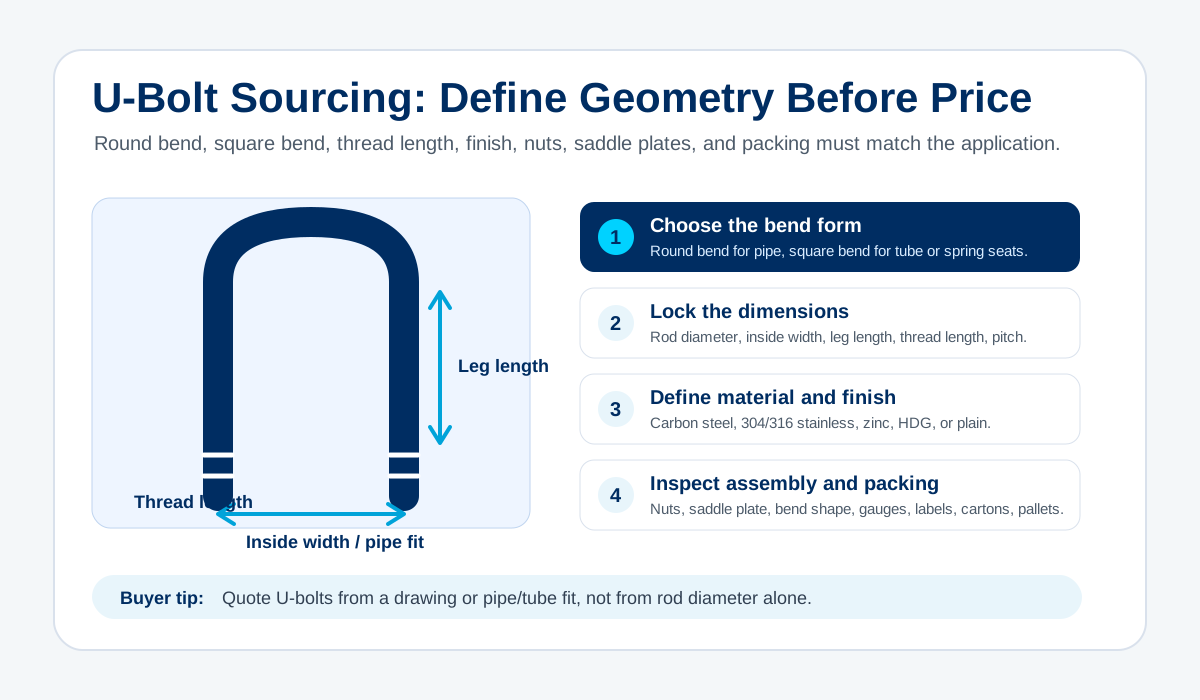
Short answer for U-bolt buyers
A U-bolt is a bent rod fastener with two threaded legs. It is used to clamp round pipe, square tube, exhaust components, trailer parts, leaf springs, structural members, and other parts that need a wrap-around fastening method. Round-bend U-bolts are normally selected for pipe or round sections. Square-bend U-bolts are normally selected for square tube, flat seats, brackets, or spring assemblies.
Buyers should avoid asking only for "M10 U-bolt" or "1/2 inch U-bolt." That describes the rod diameter, but it does not define the part. Two U-bolts with the same rod diameter can have different inside widths, bend radius, leg length, thread length, pitch, nuts, saddle plates, finish, and packing.
| Buying question | What to define | Why it matters |
|---|---|---|
| Bend form | Round bend, square bend, semi-round bend, or drawing match | Controls fit against pipe, tube, spring seat, or bracket |
| Rod and thread | Rod diameter, thread size, pitch, thread length, and thread standard | Controls nut fit, clamp load, and assembly compatibility |
| Clamp geometry | Inside width, inside height, leg length, bend radius, and tolerance | Prevents loose fit, interference, or insufficient thread engagement |
| Application | Pipe clamp, exhaust clamp, trailer hardware, leaf spring, beam strap, or custom fixture | Helps choose bend form, material, finish, saddle plate, and packing |
| Supplied parts | U-bolt only, two nuts, washers, saddle plate, plate washer, or full kit | Assembly kits must be sourced and packed as matched sets |
| Finish | Plain, zinc plated, hot-dip galvanized, black oxide, stainless, or project-approved coating | Finish affects corrosion resistance, thread fit, appearance, and cost |
Round bend vs square bend U-bolts
The bend form is the first sourcing decision. A round-bend U-bolt wraps around pipe or other round sections. A square-bend U-bolt sits around rectangular or square sections and gives flatter contact at the corners or seat area. If the U-bolt is used with a saddle plate, the saddle shape should also match the clamped part.
| Feature | Round bend U-bolt | Square bend U-bolt |
|---|---|---|
| Typical application | Pipe clamps, exhaust systems, conduit supports, round posts | Square tube, trailer hardware, leaf spring seats, brackets, beam straps |
| Critical dimension | Inside width or pipe outside diameter fit | Inside width, inside height, and corner radius |
| Common accessories | Hex nuts, washers, curved saddle plate, pipe clamp plate | Hex nuts, flat plate, square saddle, heavy plate washer |
| Main sourcing risk | Wrong pipe fit or bend radius creates point contact or loose clamping | Wrong inside height or corner shape prevents the part from seating |
| Best RFQ input | Pipe OD, drawing, or sample plus rod diameter and leg length | Tube size, bracket drawing, or sample plus leg and thread requirements |
Dimensions buyers should put on the drawing
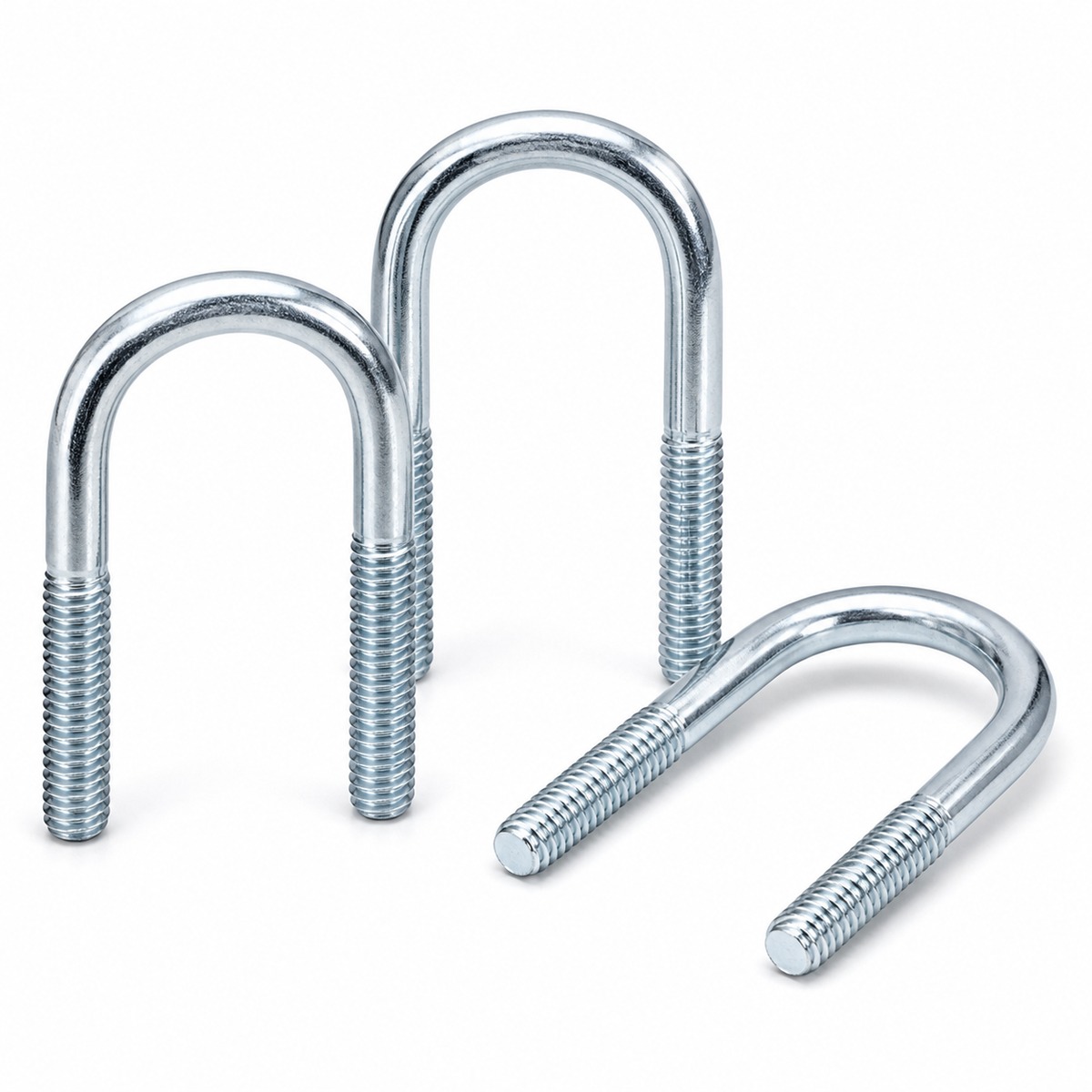
A U-bolt drawing does not need to be complicated, but it must show the controlled dimensions. At minimum, include rod diameter, inside width, inside height or leg length, thread length on each leg, thread pitch, and the radius or bend form. If the part clamps pipe, state the pipe outside diameter or nominal pipe size and whether a saddle plate is used.
For replacement U-bolts, photos help only when paired with measurements. A supplier cannot reliably quote from a photo of a rusty clamp without the inside width, leg length, thread size, and finish requirement. If the assembly uses a plate, send the plate hole spacing and thickness too.
Material and finish choices
Carbon steel U-bolts are common for general industrial hardware, construction clamping, vehicle hardware, and distributor stock. Stainless steel U-bolts are used where corrosion resistance or clean appearance matters. For stainless U-bolt programs, compare the application with HDBOLT's stainless steel A2 vs A4 fastener guide before choosing 304/A2 or 316/A4 material.
Common finishes include plain, zinc plated, hot-dip galvanized, black oxide, and stainless self-finish. Hot-dip galvanized U-bolts need extra attention because coating thickness can affect thread assembly with nuts. For outdoor construction hardware, compare the finish decision with the zinc plated vs hot-dip galvanized fastener guide.
| Finish | Typical use | Buyer note |
|---|---|---|
| Zinc plated | Indoor hardware, light outdoor exposure, distributor stock | Define color, coating expectation, and salt-spray requirement if controlled |
| Hot-dip galvanized | Outdoor steelwork, pipe supports, utility and construction hardware | Confirm thread fit with matching nuts after coating |
| Plain or black | Welded assemblies, temporary protection, machinery where coating is handled later | Clarify oiling, rust prevention, and storage expectation |
| Stainless steel | Marine, food-adjacent, clean appearance, or corrosive environments | Define 304/A2 or 316/A4 and confirm nut material match |
Should the order include nuts, washers, or saddle plates?
Many U-bolt problems come from sourcing the bent rod separately from the assembly parts. If the U-bolt is sold as a kit, define exactly what is included: two hex nuts, four nuts, washers, saddle plate, flat plate, or special clamp plate. If the plate has holes, the hole spacing must match the U-bolt leg spacing after bending and coating.
For pipe clamping, a saddle plate can spread load and improve seating. For structural straps or square tube, a flat or formed plate may be required. If the assembly will be packed for retail or field installation, specify one kit per bag or box, label format, barcode, and whether loose nuts are acceptable.
Handan Yongnian sourcing context for custom U-bolts
U-bolts fit naturally into Handan Yongnian sourcing because many orders combine standard rod/threading work with bending, plating, nuts, washers, plates, and export packing. The cluster can be useful for overseas buyers who need several U-bolt sizes, matching nuts, plate washers, and related bolt products consolidated in one shipment.
Mixed U-bolt orders require careful item identification because inside widths and thread lengths can differ by only a few millimeters. HDBOLT confirms drawings, item codes, sample photos, plate fit, carton labels and pallet separation before export.
Inspection points before shipment
U-bolt inspection should cover more than thread gauges. The bend must be symmetrical, the legs should be parallel within the buyer's tolerance, the inside width should match the drawing, and the thread length should be long enough for the nut and clamped thickness. For assembled kits, inspect nut fit, plate hole spacing, and whether each carton contains the correct kit components.
| Inspection item | What to check | Evidence to request |
|---|---|---|
| Geometry | Inside width, inside height, leg length, bend radius, parallel legs | Caliper photos, jig photos, sample measurement table |
| Thread | Thread size, pitch, thread length, gauge fit, nut assembly | Go/no-go gauge photos and assembled nut photos |
| Finish | Coating coverage, color, rust prevention, thread fit after coating | Surface photos and coating confirmation |
| Accessories | Nuts, washers, saddle plates, flat plates, kit completeness | Kit layout photo and carton packing photo |
| Packing | Item code, size label, quantity, carton weight, pallet separation | Label photos, carton count, pallet photos |
Common RFQ mistakes
- Writing only the rod diameter, such as "M12 U-bolt," without inside width or leg length.
- Not saying whether the part is round bend or square bend.
- Leaving out thread length, which causes poor nut engagement after installation.
- Ordering U-bolts and plates separately without checking hole spacing.
- Specifying hot-dip galvanizing without confirming nut fit after coating.
- Packing similar U-bolt sizes in plain cartons without item-code labels.
RFQ wording buyers can copy
Round-bend U-bolt, carbon steel, M12 rod diameter, coarse metric thread, inside width 76 mm, leg length 160 mm, thread length 45 mm each leg, zinc plated, supplied with two matching hex nuts and flat washers, packed 50 sets per carton with item-code labels. Provide bend measurement photos, thread gauge photos, assembled nut photos, packing photos, and destination-ready pallet plan.
Square-bend U-bolt for trailer bracket, 1/2 inch rod diameter, UNC thread, inside width and height per drawing, thread length per drawing, hot-dip galvanized, supplied with two nuts and one plate washer. Confirm thread fit after galvanizing, plate hole spacing, sample approval, carton weight, and required export documents.
What HDBOLT recommends
Start with the clamped part and the drawing. Then define the U-bolt geometry, material, finish, accessories, inspection, and packing line by line. For an accurate quote, send the drawing or sample measurements, application, size list, quantity, finish, kit components, packing requirement, and destination through the HDBOLT contact page. For wider sourcing context, review the HDBOLT supply and quality guide and the HDBOLT U-bolt product page.